
Fitzpatrick Type III is the effective baseline for East Asian skin. This guide covers the scientific definition of Type III, melanin characteristics, UV response patterns, and the most common concerns — melasma, PIH, and uneven tone — grounded in dermatological research.

What Is Fitzpatrick Type III?
The Fitzpatrick Scale is the international standard skin classification system developed in 1975 by American dermatologist Thomas B. Fitzpatrick. It classifies skin into six types (I–VI) based on how it reacts to ultraviolet radiation, and is used as a standard reference in dermatology and skin science research worldwide.
Type III (Fitzpatrick Skin Type III) sits at the midpoint of this classification. Skin tone ranges from light beige to medium golden tan (ITA° 10–41°), and this type is most common among East Asians (Korean, Japanese, Chinese), Southern Europeans, and some Latinos.
Types I and II are “always-burn” fair skin; Types IV–VI are “rarely-burn” darker skin. Type III falls between — skin that occasionally reddens but reliably tans, gradually and evenly deepening in color with UV exposure.
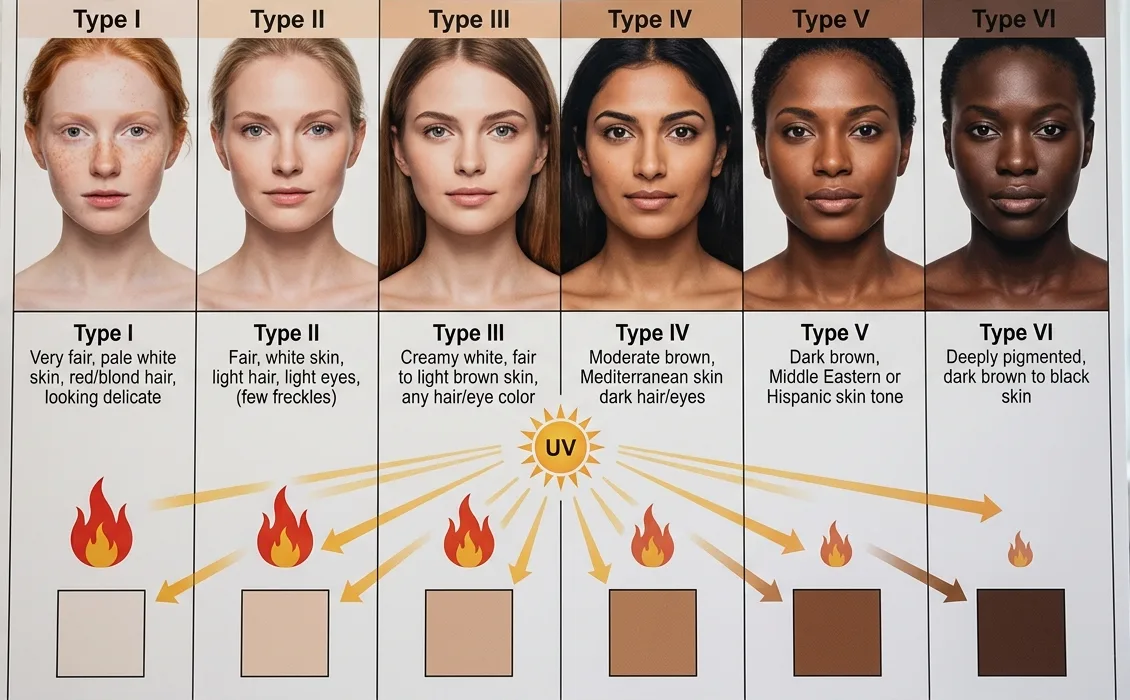
Full 6-Type Fitzpatrick Overview
| Type | Skin Color | UV Response | Tanning | Common Population |
|---|---|---|---|---|
| I | Very pale, often freckled | Always burns, never tans | None | Northern European |
| II | Fair | Usually burns, rarely tans | Minimal | Northern European / British |
| III | Fair to medium | Sometimes burns, always tans | Gradual | Korean / East Asian |
| IV | Medium to olive | Rarely burns, always tans | Easy | Mediterranean / Middle Eastern |
| V | Brown to dark brown | Very rarely burns | Very easy | South Asian / Hispanic |
| VI | Very dark brown to black | Never burns | Always | African descent |
Key point: The Fitzpatrick classification is not simply “light vs. dark skin” — it measures the biological UV reactivity of melanin.
How Common Is Type III Among East Asians?
Most Koreans Are Type III or IV
Multiple dermatological studies show that 40–50% of Koreans are Type III and 30–40% are Type IV — together accounting for roughly 70–85% of the population. Types I and II combined represent only about 10%, and Type V or above is around 5%. Type III covers the widest spectrum and effectively represents the baseline skin reference for Korean skin.
Note: Distribution varies by study, region, and measurement method. Figures are estimates based on Korean dermatological literature.
Why Is Type III So Prevalent in East Asians?
East Asian skin, including Korean skin, has a higher ratio of eumelanin and larger melanosome distribution compared to European skin. This means UV exposure triggers tanning rather than erythema as the primary response — resulting in more individuals classifying as Types III–IV.
Dermatological Characteristics of Type III
Melanin Distribution
The most important feature of Type III skin is its eumelanin-dominant melanin profile.
- Eumelanin: Brown to black pigment. High UV-shielding efficiency causes tanning toward Type IV.
- Pheomelanin: Red to yellow pigment. More prominent in Types I–II.
Type III has sufficient eumelanin but not enough to achieve consistent “always blocked” protection like Type IV. This intermediate position means UV response varies significantly depending on exposure — Type III’s defining characteristic.
Understanding Type III Through ITA° (Individual Typology Angle)
ITA° is an objective skin brightness measurement based on L*a*b* color space — more precise than the questionnaire-based Fitzpatrick classification.
| ITA° Range | Brightness Level | Approximate Fitzpatrick |
|---|---|---|
| Above 55° | Very Light | I |
| 41–55° | Light | II |
| 28–41° | Intermediate (lighter Type III) | III |
| 10–28° | Tan (mid Type III) | III–IV boundary |
| -30–10° | Brown | IV–V |
| Below -30° | Dark | V–VI |
The ITA° range for Type III spans 10–41° — quite broad. A “lighter Type III” and a “darker Type III” can look visually very different.
Four Scientific Characteristics of Type III in East Asian Skin
① High Pigmentation Reactivity
Melanin overproduces rapidly in response to UV, inflammation, or friction — leaving pigmentation more readily than Types I–II under the same stimulus.
② Lower Erythema Threshold
Not fully protected, so UV exposure causes mild redness — though far less severe than Types I–II, and most transitions to tanning within days.
③ Relatively Thicker Stratum Corneum
East Asian skin tends to have a denser outer layer than European skin. While this provides a physical barrier, it can cause dullness when not properly exfoliated.
④ Higher PIH (Post-Inflammatory Hyperpigmentation) Risk
Dark marks left after acne, wounds, or friction resolve more deeply and persist longer in Type III skin than in Types I–II. PIH becomes a clinically significant concern from Type III onward.
UV Response and Tanning Patterns
Type III UV Response Stages
In some individuals, mild flushing appears within hours of UV exposure. Within 24 hours, a sunburned feeling and mild erythema develop. By days 3–7, the redness fades and melanin increases — skin visibly darkens. Once UV exposure decreases, skin gradually returns to baseline over weeks to months, following the natural cell turnover cycle.
Minimal Erythema Dose (MED) and Type III
MED is the minimum UV dose required to produce erythema.
- Type I MED: ~15–25 mJ/cm²
- Type II MED: ~25–35 mJ/cm²
- Type III MED: ~35–55 mJ/cm²
- Type IV MED: ~55–75 mJ/cm²
Type III’s higher MED means severe burns are unlikely from routine daily exposure — but long-term cumulative UV damage, photoaging, and hyperpigmentation can be more pronounced. Not burning easily is not a reason to skip sun protection.
Common Skin Concerns in Type III
① Melasma — The Most Prevalent Concern
Melasma appears as irregular brown patches, typically symmetric, on the cheeks, forehead, and upper lip. It is more prevalent in Type III–IV skin, and Korean women show significantly higher melasma rates than Western women according to domestic dermatology research.
Melasma aggravating factors:
- UV radiation (the most powerful trigger)
- Female hormones (estrogen, progesterone) — worsens during pregnancy or with oral contraceptives
- Thyroid dysfunction
- Heat stimulation (including infrared radiation)
Melasma recurs frequently and is difficult to treat. Sun protection is the first priority in melasma management.
② PIH (Post-Inflammatory Hyperpigmentation)
The brown mark left after acne heals, or skin that darkens after a wound — these are PIH. In Type III skin, the same degree of inflammation leaves deeper, longer-lasting pigmentation than in Types I–II.
| PIH Severity | Expected Recovery | Care Approach |
|---|---|---|
| Mild (pink to light brown) | 3–6 months | Niacinamide, sunscreen |
| Moderate (brown) | 6–12 months | Alpha-arbutin, vitamin C, tranexamic acid |
| Severe (dark brown / grayish) | 12+ months | Consider dermatological procedures (laser, chemical peel) |
③ Uneven Skin Tone
Areas with more sun exposure (forehead, nose, cheekbones) and less exposed areas (chin, under-eyes) develop visible color differences. Type III makes this unevenness more noticeable than in Type I skin.
④ Photoaging
UV radiation breaks down collagen fibers in the skin alongside melanin increase. Frequent long-term sun exposure in Type III skin leads to combined progression of dark spots, wrinkles, and texture changes. Photoaging in East Asians tends to appear relatively later than in Western skin, but when it does appear, pigment changes are the dominant feature.
⑤ Enlarged Pores and Excess Sebum (Type III Oily Skin)
While Fitzpatrick type and skin type (dry/oily) are distinct classifications, a high proportion of Type III Koreans are oily or combination skin. Increased sebum production leads to enlarged pores and excess oiliness.
Sun protection strategy, skincare routine, key ingredients, and makeup guide continue in the Type III Care Guide →.
This content is for informational purposes only. For severe melasma, PIH, or hyperpigmentation, consultation with a board-certified dermatologist is recommended.