
What Is Skin Color?
Skin color cannot be reduced to a simple “light or dark” spectrum. It is an optical outcome shaped by the type, quantity, and distribution of pigments combined with circulatory status — a genuinely complex biological phenomenon.
Its significance extends well beyond appearance. Skin pigmentation is a biological defense system against ultraviolet radiation, a clinical indicator of health status, and the scientific foundation for makeup selection, personal color analysis, and skincare routine design.
The Three Core Determinants of Skin Color
According to Grieve’s (1991) spectrophotometric analysis of human skin, color is governed by the relative concentrations of three primary pigments and chromophores.
① Melanin — The Most Important Factor
Melanin is the dominant pigment determining skin color. Present in skin, hair, and eyes, higher melanin content produces darker skin while lower amounts yield lighter tones. In the complete absence of melanin, skin appears pale white with a pinkish hue from underlying blood flow.
② Hemoglobin — The Source of Redness
Hemoglobin in red blood cells generates the reddish tones in skin. Oxyhemoglobin produces a red hue, while deoxyhemoglobin appears blue-violet — meaning circulatory state directly influences skin appearance. Grieve (1991) confirmed through spectral analysis that the reflectance ratio of oxyhemoglobin is a key variable in undertone classification.
③ Carotenoids — The Source of Yellow Warmth
Carotenoid pigments found in carrots, pumpkins, and tomatoes contribute the yellow warmth in skin. Particularly prominent in East Asian skin tones, the warm golden quality shifts with dietary intake.
Key Takeaway: Skin color = Melanin (brown/black) + Hemoglobin (red/blue) + Carotenoids (yellow)
Two Types of Melanin: Eumelanin vs. Pheomelanin
Melanin is not a single compound. In their landmark Nature review, Lin & Fisher (2007) established that the ratio of two distinct melanin subtypes is the central determinant of skin color, hair color, and UV reactivity.
Eumelanin — Brown and Black Tones
- Color: Brown to black
- UV Protection: Exceptional. Brenner & Hearing (2008) demonstrated that eumelanin converts UV energy into heat, blocking over 99% of potential DNA damage
- Distribution: Darker skin tones, brown and black hair
- Sun Response: Tans readily with minimal burning; strong photoprotection
Pheomelanin — Red and Yellow Tones
- Color: Pink, red, and yellow
- UV Protection: Comparatively weak
- Distribution: Fair skin, red hair, freckles
- Important: Brenner & Hearing (2008) found that pheomelanin generates reactive oxygen species (ROS) upon UV exposure, potentially causing DNA damage rather than preventing it — which is why sunscreen is especially critical for fair-skinned individuals
The Molecular Mechanism of Melanin Synthesis
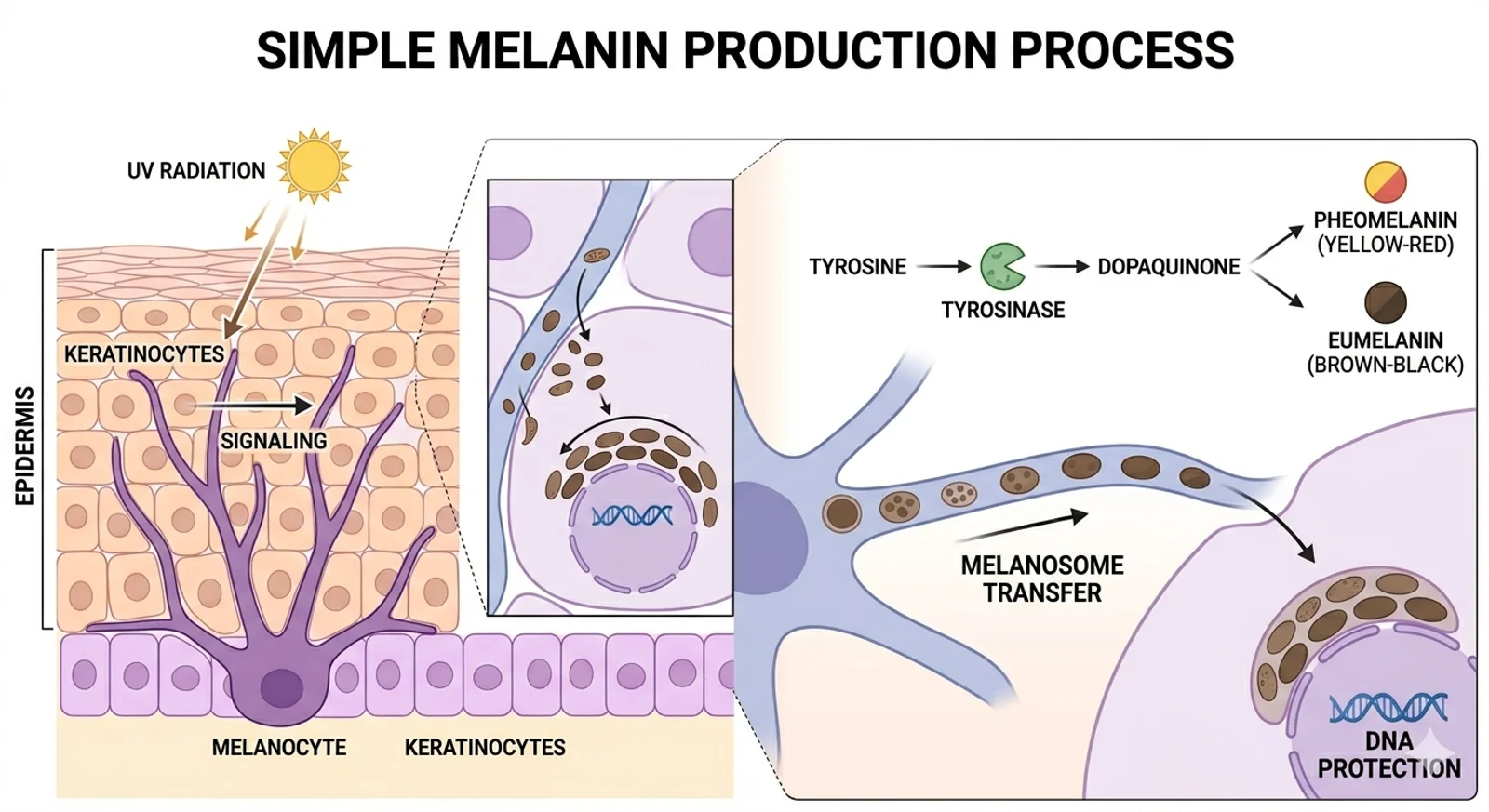
Step 1 — Origin: The Melanocyte
The basal layer of the epidermis contains specialized cells called melanocytes. According to Cichorek et al. (2013), approximately 800–1,500 melanocytes exist per mm² of skin — and this number is virtually identical across all ethnic groups. Differences in skin color arise not from cell count, but from cellular activity levels and melanin output.
Step 2 — MITF: The Master Switch of the Melanocyte
The central regulator of melanin production is MITF (Microphthalmia-associated Transcription Factor). Levy, Khaled & Fisher (2006) identified MITF as the master transcription factor governing melanocyte differentiation, survival, and pigment production. MITF directly activates the genes encoding melanin-synthesizing enzymes: tyrosinase (TYR), TRP-1, and TRP-2.
Step 3 — The MC1R Gene: Determining Melanin Type
MC1R (Melanocortin 1 Receptor) is the gene that decides which type of melanin is produced. Valverde et al. (1995) published in Nature Genetics that MC1R variants are strongly associated with red hair, fair skin, and freckles.
- Functional MC1R: α-MSH hormone signal → eumelanin (brown/black) production
- MC1R variant: Reduced signaling → switches to pheomelanin (red/yellow) production
↓
MC1R receptor activation
↓
MITF transcription factor upregulated
↓
Tyrosinase (TYR) enzyme activation
↓
Tyrosine → DOPA → Dopaquinone
├─ Eumelanin (functional MC1R)
└─ Pheomelanin (MC1R variant)
Step 4 — Melanosome Transfer and Skin Color Completion
Completed melanin is packaged into melanosomes and transported via dendritic processes into surrounding keratinocytes. Costin & Hearing (2007) established that differences in melanosome size, maturation, and transfer efficiency are the actual mechanisms behind racial variation in skin color.
Step 5 — Melanin Removal with Skin Turnover
Melanin resides within keratinocytes and is shed along with the approximately 28-day epidermal turnover cycle. This is the molecular explanation for why a tan gradually fades without continued UV exposure.
Why Skin Color Differs Across Ethnicities
A widely held misconception deserves correction:
People of all ethnic backgrounds have approximately the same number of melanocytes.
Ethnic variation in skin color is determined not by melanocyte count, but by the following factors (Costin & Hearing, 2007):
- Melanosome size: Darker skin has larger, individually distributed melanosomes; lighter skin has smaller, clustered ones
- Melanosome activity and maturation: Differences in output volume and completion
- Eumelanin-to-pheomelanin ratio: Overwhelmingly higher eumelanin in darker skin
- MC1R genotype distribution: Different variant frequencies across populations
Analogy: Think of melanocytes as factories — the number of factories (melanocyte count) is the same, but the factory scale (melanosome size) and production method (eumelanin vs. pheomelanin) determine output and quality.
Acquired Factors That Influence Skin Color
UV Radiation — The Most Powerful Factor
UV exposure triggers the pituitary to release α-MSH (melanotropin). According to Abdel-Malek (2001), α-MSH binds to MC1R, stimulates melanocytes, and amplifies melanin production through the MITF → tyrosinase pathway. This is the molecular mechanism of tanning.
Hormonal Changes
The surge in estrogen and progesterone during pregnancy significantly promotes melanin production. This is why approximately 50–70% of pregnant women develop melasma. Oral contraceptive use and thyroid dysfunction affect pigmentation through the same pathway.
Post-Inflammatory Hyperpigmentation (PIH)
During the healing of acne, wounds, or eczema, excess melanin is produced at the inflammation site. PIH tends to be more pronounced and persistent in Fitzpatrick scale types IV–VI (darker skin tones) (Fitzpatrick, 1988).
Diet and Aging
Carotenoid intake modulates the yellow warmth in skin tone. With age, melanocyte counts decline (estimated at approximately 10–20% per decade), while cumulative UV damage causes uneven pigment distribution, leading to melasma and age spots.
Pigmentation Disorders: Hyper- and Hypopigmentation
Hyperpigmentation
| Condition | Cause | Characteristics |
|---|---|---|
| Melasma | UV + hormones | Symmetrical brown patches; primarily on cheeks and forehead |
| Freckles (Ephelides) | Genetic (MC1R variant) + UV | Small spots on nose and cheeks; pheomelanin-dominant |
| Post-Inflammatory Hyperpigmentation (PIH) | Post-acne/wound | Brown pigment residue at inflammation site |
| Senile Lentigo (Age Spots) | Cumulative UV + aging | On hands and face; localized melanocyte proliferation |
Hypopigmentation
| Condition | Cause | Characteristics |
|---|---|---|
| Vitiligo | Autoimmune destruction of melanocytes | Irregular white patches with sharp borders |
| Albinism | TYR gene deficiency | Total absence of pigment; unprotected from UV |
| Post-Inflammatory Hypopigmentation | Severe skin damage | Depigmentation at wound site |
If you suspect a pigmentation disorder, consult a board-certified dermatologist.
Skin Color and Makeup: The Scientific Connection
The Molecular Origin of Undertone
Undertone — the foundational concept in personal color analysis — is not merely a subjective impression. It originates from measurable pigment ratios at the molecular level:
- Warm Tone: Higher eumelanin + carotenoid ratio → golden, olive warmth
- Cool Tone: Higher pheomelanin + oxyhemoglobin ratio → pink, rosy hue
- Neutral Tone: A balance of both
How Brightening Ingredients Work
Understanding the skin color mechanism reveals why specific ingredients are effective:
| Ingredient | Target | Mechanism |
|---|---|---|
| Vitamin C | Tyrosinase inhibition + melanin oxidation reduction | Blocks synthesis + lightens existing pigment |
| Niacinamide | Melanosome-to-keratinocyte transfer inhibition | Prevents pigment from spreading |
| Retinol | Accelerates epidermal cell turnover | Speeds removal of pigmented cells |
| Arbutin | Competitive tyrosinase inhibition | Blocks melanin synthesis at the source |
| AHA (Glycolic Acid) | Promotes exfoliation | Physical removal of pigmented cells |
Applying This to Foundation Selection
- Melanin quantity → Luminosity (shade depth): Guides N (Neutral), C (Cool), W (Warm) numbering
- Undertone → Color tone selection: Pink, beige, yellow, olive, etc.
Frequently Asked Questions
Q. Do Black people have more melanocytes? A. No. Melanocyte count is virtually equal across all ethnicities (Cichorek et al., 2013). The difference lies in melanosome size and activity, and in the eumelanin-to-pheomelanin ratio.
Q. Are personal color and skin color the same thing? A. No. Skin color refers to luminosity (brightness) based on melanin quantity, while personal color is classified by undertone (hue). A person with light skin can have a warm undertone, and someone with dark skin can have a cool undertone.
Q. Can sunscreen alone prevent melasma? A. UV protection is the most effective preventive measure, but hormonal changes and inflammation are separate pathways. Combining sunscreen with brightening actives (Vitamin C, niacinamide) yields better results.
Q. Why does a tan fade over time? A. Melanin resides within keratinocytes and is eliminated during the ~28-day skin turnover cycle. Once UV stimulation ceases, new melanin production decreases and skin gradually brightens.
“Melanocytes are not mere pigment factories. They are biological sensors that integrate stress, hormone, and UV signals to orchestrate real-time skin defense.” — Costin & Hearing, 2007