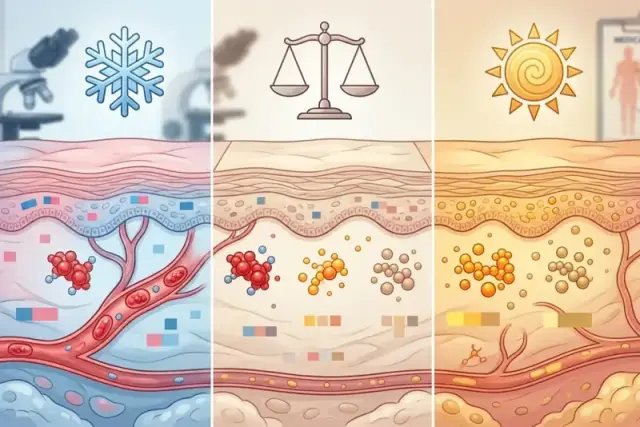
Undertone is the biological color base of the skin, classified into warm, cool, and neutral. Independent of surface skin color (lightness), it is a permanent biological constant that serves as the foundational criterion for makeup, fashion, and personal color analysis.

Undertone — Warm, Cool & Neutral Skin Color Base Classification

What Is Undertone: A Dermatological Definition

Undertone is the color base residing in the subepidermal layer (dermal vascular layer) of the skin. Unlike surface skin tone — which changes with sun exposure, seasons, health, and makeup — undertone is a biological constant that remains stable throughout a person’s lifetime.

Grieve (1991) identified four pigment systems that determine skin color in combination:

PigmentColor ContributionUndertone Influence
OxyhemoglobinRed·pink basePrimary determinant of cool undertone
DeoxyhemoglobinBlue·purple baseDeepens cool undertone
CarotenoidsYellow·golden basePrimary determinant of warm undertone
Melanin (Eumelanin·Pheomelanin)Brown·neutral baseRegulates neutral tone and overall hue

Weatherall & Coombs (1992) demonstrated via CIELAB colorimetry that the a* (red-green axis) and b* (yellow-blue axis) values differ significantly between individuals — providing the objective measurement basis for undertone classification.

내 피부톤을 직접 분석해보세요

사진 한 장으로 언더톤·퍼스널컬러를 AI가 분석합니다.

지금 바로 분석해보기

The Dermatological Science of Each Undertone

Warm Undertone

Characterized by dominant carotenoids + elevated pheomelanin + warm yellow-spectrum oxyhemoglobin reflection.

According to Rees (2003), pheomelanin is a red-yellow pigment; the higher the pheomelanin-to-eumelanin ratio, the more golden and peachy the skin appears.

Skin Characteristics

  • Skin base: golden, peach, ivory, warm beige
  • Sun response: tends to tan to a golden color
  • Natural flush: warm peach-apricot toned blush

Visual Self-Check Indicators

TestWarm Tone Signal
Wrist vein colorGreen or olive-toned
White paper testSkin reflects golden or ivory
Metal preferenceGold jewelry looks most natural
Tanning responseEven golden tan

For color swatches and full makeup application guidance, see the Warm, Cool & Neutral Practical Guide.


Cool Undertone

Characterized by dominant oxyhemoglobin·deoxyhemoglobin + low carotenoids + higher eumelanin ratio.

Del Bino & Bernerd (2013) found that higher blood flow volume and hemoglobin reflection in the skin’s surface layer produces stronger pink-blue cool undertones.

Skin Characteristics

  • Skin base: pink, rosy, lavender-tinged, cool beige
  • Sun response: tends to burn red rather than tan golden
  • Natural flush: cool pink-rose toned blush

Visual Self-Check Indicators

TestCool Tone Signal
Wrist vein colorBlue or purple-toned
White paper testSkin reflects pink or rose
Metal preferenceSilver or white gold looks most natural
Tanning responseBurns red or doesn’t tan easily

For color swatches and full makeup application guidance, see the Warm, Cool & Neutral Practical Guide.


Neutral Undertone

Characterized by a balanced state of carotenoid and hemoglobin reflection — neither warm nor cool is distinctly dominant.

In Weatherall & Coombs’ (1992) CIELAB measurements, skin with a* and b* values both in the mid-range corresponds to the neutral undertone.

Skin Characteristics

  • Skin base: beige, cream, soft ivory (no strong temperature bias)
  • Sun response: mild — can both burn slightly and tan lightly
  • Natural flush: subtle, neutral-toned

Visual Self-Check Indicators

TestNeutral Tone Signal
Wrist vein colorBlue-green (difficult to distinguish)
White paper testSkin reflects beige or cream
Metal preferenceBoth gold and silver look flattering
Tanning responseModerate, mild tan

For color swatches and full makeup application guidance, see the Warm, Cool & Neutral Practical Guide.


Warm · Cool · Neutral at a Glance

WarmCoolNeutral
Dominant pigmentCarotenoids + pheomelaninHemoglobin + eumelaninBalanced
Skin baseGolden, peach, ivoryPink, lavender, cool beigeBeige, cream
Vein colorGreen, oliveBlue, purpleBlue-green
Sun responseGolden tanBurns redModerate
Best metalGoldSilver, white goldBoth
Signature colorsCoral, terracotta, mustardLavender, rose, burgundyWide palette
Personal colorSpring Warm, Autumn WarmSummer Cool, Winter CoolAll seasons possible

자가진단 체크리스트

해당하는 항목을 모두 체크해보세요

웜톤·쿨톤 항목에 5개 이상 해당하면 해당 언더톤일 가능성이 높습니다.

웜톤 체크0 /7
쿨톤 체크0 /7

Undertone Characteristics in Korean and Asian Skin

According to Kim & Park (2019), Koreans concentrate within the Fitzpatrick III–IV range with medium melanin density, producing specific characteristics in undertone identification:

  • Warm/cool boundary is subtler than in Western populations: The difference between carotenoid and hemoglobin levels is relatively smaller, making the vein test alone unreliable
  • Higher proportion of neutral: An estimated 30–40% of Koreans fall in the neutral category
  • Beware of “yellow cast” misidentification: The melanin characteristics of Korean skin can create a surface yellow cast even when the actual undertone is cool

Chung (2014) noted that Asian skin tends to have higher carotenoid concentrations than European skin — meaning that a warm surface appearance does not necessarily confirm a warm undertone, and multiple tests are required.


The Color Harmony Science Behind Undertone

Based on Eiseman (2000) and Itten’s (1961) color theory, undertone-based color selection works through the principle of Simultaneous Contrast:

  • Warm-tone skin + warm clothing: The warm colors amplify the skin’s golden base → looks healthy and vibrant
  • Cool-tone skin + cool clothing: The cool colors neutralize the skin’s pink base → creates a refined, sophisticated impression
  • Mismatched undertone clothing: Color temperature conflict between skin and clothing → skin appears dull or puffy

Jackson (1987) explained: “The right undertone colors visually minimize facial redness and imperfections, while the wrong colors amplify them.”


Undertone and Personal Color

Undertone is the primary classification criterion in personal color analysis. After determining warm/cool, brightness and chroma are added to subdivide into 4-season or 12-season categories.

UndertoneBrightnessChromaPersonal Color Season
WarmBrightVividSpring Warm
WarmDeepMuted, richAutumn Warm
CoolBrightSoft, mutedSummer Cool
CoolDeepVivid, strongWinter Cool

Kim & Park (2019) found that even within the same undertone, the most flattering color palette shifts significantly based on brightness and chroma — explaining why someone might say “I’m warm-toned, but coral doesn’t suit me.”


Common Misconceptions

MisconceptionFact
”Tanning in summer changes your undertone”Undertone is a biological constant. Only surface skin tone changes
”Fair-skinned people are always cool-toned”Light skin can have warm undertones — brightness and undertone are independent variables
”All East Asians are warm-toned”Approximately 30–40% of Koreans are cool or neutral
”Blue veins always mean cool-toned”Vein color is one reference indicator — low reliability when used alone
”Makeup can change your undertone”Makeup adjusts surface color only — undertone itself doesn’t change
”Neutral means no undertone”Neutral has an undertone — it’s a balanced state of warm and cool

Frequently Asked Questions

Q. Does undertone really never change? The carotenoid, hemoglobin, and melanin ratios that determine undertone are genetically set biological constants. Dramatic hormonal shifts — pregnancy, menopause, illness — can cause subtle shifts, but a category change from warm to cool is extremely rare.

Q. What if my vein test and metal test give different results? Undertone determined from a single test has low reliability. Run 3+ tests (veins, metal, white paper, clothing harmony) and go with the majority result. If results are evenly distributed across both, neutral is likely.

Q. What if AI analysis and self-diagnosis disagree? AI analysis is affected by photo color temperature and lighting conditions. Retake under natural light without filters, then cross-reference with self-diagnosis results.

Q. How do I apply undertone in makeup? For foundation label keywords, blush shades, and full makeup guidance with color swatches, see the Warm, Cool & Neutral Practical Guide.

내 피부톤을 직접 분석해보세요

사진 한 장으로 언더톤·퍼스널컬러를 AI가 분석합니다.

지금 바로 분석해보기

Key Takeaways

  • Undertone is a biological constant determined by oxyhemoglobin, carotenoids, and melanin ratios
  • Warm: dominant carotenoids + pheomelanin → golden-peach base, green veins, gold jewelry
  • Cool: dominant hemoglobin, low carotenoids → pink-lavender base, blue veins, silver jewelry
  • Neutral: warm-cool balance → beige-cream base, broad color compatibility
  • ~30–40% of Koreans are in the neutral category — use multiple tests, not just one
  • Undertone is the primary criterion in personal color — brightness and chroma then subdivide into 4 or 12 seasons

RELATED

→ Warm · Cool · Neutral Practical Guide — Foundation & Blush Selection→ Spring Warm Complete Guide→ Summer Cool Complete Guide→ Autumn Warm Complete Guide→ Winter Cool Complete Guide→ Self Personal Color Diagnosis