
The Fitzpatrick Scale is the international standard skin classification system developed in 1975 by Thomas B. Fitzpatrick of Harvard Medical School. It classifies UV responses into six types (I–VI), and is applied across dermatological practice from laser parameter settings to sunscreen prescriptions. Koreans primarily fall in Types III–IV and show higher PIH incidence than Western skin at the same type.
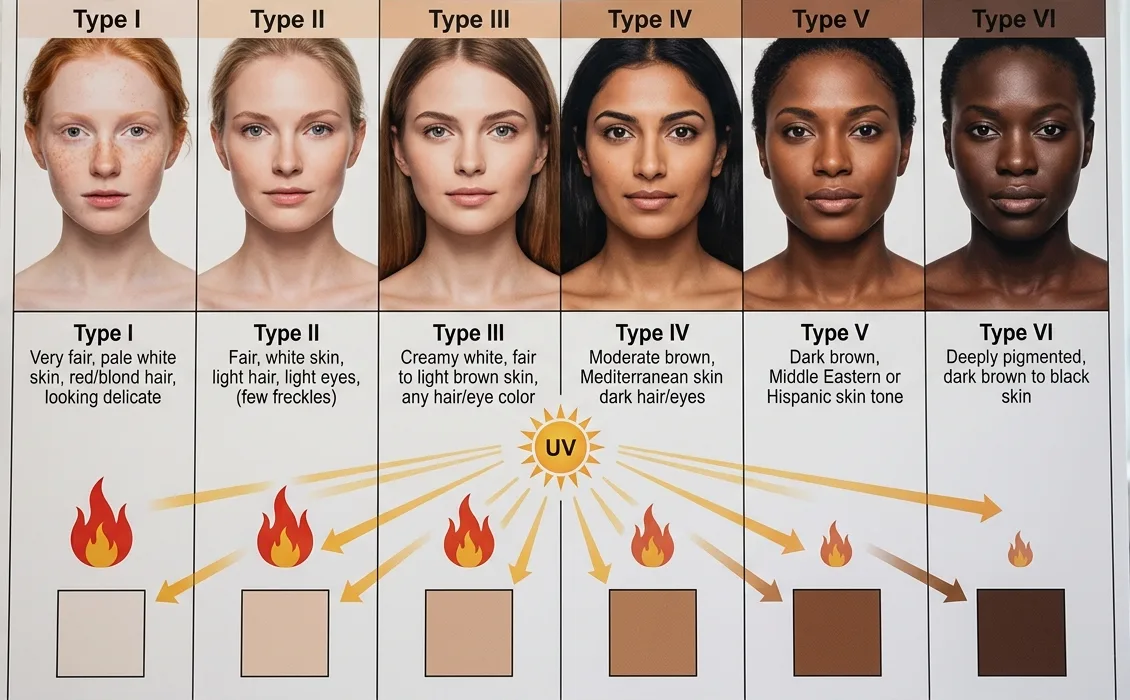
What Is the Fitzpatrick Scale?
The Fitzpatrick Skin Type Scale is a classification system developed in 1975 by Thomas B. Fitzpatrick of Harvard Medical School, originally created to safely determine phototherapy (PUVA therapy) dosages. Expanded and refined to Types I–VI in 1988, it remains the international standard clinical tool in dermatology today.
Three Classification Criteria:
- Burn tendency — How easily does the skin burn under UV exposure?
- Tan ability — How well does the skin tan after UV exposure?
- Constitutional skin color — The skin’s natural color without sun exposure
Fitzpatrick (1988) emphasized that this system is not merely a skin color classification but a biological indicator measuring melanin reactivity. Del Bino & Bernerd (2013) confirmed that higher eumelanin content corresponds to a higher Fitzpatrick number, which directly correlates with UV protection capacity.
The Complete 6-Type Fitzpatrick Classification
Type I — Pale White (Extremely Sensitive)
With a constitutional color of pale white to milky, this type always burns severely — producing erythema and blisters — and never tans. Eumelanin is minimal and pheomelanin dominant, giving the lowest UV defense capacity of all six types. Red hair, freckles, and light blue or green eyes are common associated traits. Daily SPF 50+ is essential, and melanoma risk is approximately 10× higher than Type VI.
Concentrated in Northwest European (Irish, Scottish, Scandinavian) descent. Pheomelanin absorbs UV far less efficiently than eumelanin, leading to cumulative photodamage.
Type II — Fair White (Highly Sensitive)
Light white to pale beige in constitutional color, this type burns easily with persistent erythema and tans minimally or not at all. Eumelanin levels are low. Blonde to light brown hair, light eyes, and possible freckles are common. SPF 30–50+ recommended for outdoor activity, with very high skin cancer risk.
Common in Northern and Western European descent. Annual dermatological skin cancer screening is recommended (Lim et al., 2017).
Type III — Creamy White / Light Brown (Moderately Sensitive)
Creamy white to light brown in constitutional color, this type sometimes burns mildly and tans evenly to a uniform golden brown. Eumelanin and pheomelanin are balanced. A wide variety of hair and eye colors are seen. SPF 30+ recommended for outdoor activity (SPF 50+ on high-exposure days). Skin cancer risk is moderate, but PIH warrants attention.
The most common type in East Asian, Southern European, and Latin American mixed populations. Approximately 40–50% of Koreans fall into this category (Kim & Park, 2019).
Type IV — Moderate Brown (Low Sensitivity)
Medium brown to olive beige in constitutional color, this type rarely burns and tans easily and deeply. Eumelanin content is high. Dark brown to black hair and brown eyes are typical. SPF 30+ recommended for outdoor activity, with moderate to high PIH (post-inflammatory hyperpigmentation) risk.
Common in Mediterranean, Asian, and Hispanic populations. Approximately 30–40% of Koreans fall here. Chung (2014) reported that East Asian skin at Type IV shows significantly higher PIH incidence than Western counterparts at the same type.
Type V — Dark Brown (Minimal Sensitivity)
Deep brown in constitutional color, this type burns only rarely and tans very deeply. Eumelanin content is very high. Dark brown to black hair and eyes are typical. SPF 30+ recommended — UV damage still occurs. High tendency for PIH and keloid formation requires caution before laser or peel procedures (Sheth & Pandya, 2011).
Distributed in South Asian, Middle Eastern, and some African descent.
Type VI — Deep Ebony (UV Resistant)
Deep brown to black in constitutional color, this type virtually never burns and is already maximally pigmented, making tanning unmeasurable. Eumelanin content is extremely high with dense melanosomes. SPF 30+ recommended — UV damage, skin cancer, and PIH risk remain. PIH and keloid risk are very high.
Primarily in those of African descent. Taylor (2002) reported that while skin cancer incidence is lower in Type VI, delayed diagnosis results in worse prognosis.
Fitzpatrick Type Comparison at a Glance
| Type I | Type II | Type III | Type IV | Type V | Type VI | |
|---|---|---|---|---|---|---|
| Base color | Pale white | Light white | Creamy/light brown | Medium brown | Deep brown | Black-brown |
| Burning | Always | Easily | Sometimes | Rarely | Very rarely | Never |
| Tanning | None | Minimal | Even | Easily | Deeply | None (max pigment) |
| Min. SPF | 50+ | 30–50+ | 30+ | 30+ | 30+ | 30+ |
| Cancer risk | Highest | Very high | Moderate | Moderate | Low | Lowest |
| PIH risk | Low | Low | Moderate | Moderate–High | High | Very high |
| Main population | NW Europe | N Europe | E Asia, S Europe | Mediterranean, Asia | S Asia, Middle East | Africa |
Finding Your Fitzpatrick Type
For each item below, select the description that best matches you.
① Burn history
- I burn severely with less than 30 minutes of outdoor exposure → Type I–II possible
- My skin turns red after 1 hour outdoors but recovers the next day → Type III possible
- I almost never burn even with extended outdoor activity → Type IV–V possible
- I have never experienced a sunburn no matter how long I’m in the sun → Type VI possible
② Tanning response
- My skin never darkens after sun exposure → Type I
- I tan slightly but return to my original color quickly → Type II
- I tan to an even golden brown → Type III
- I tan easily, deeply, and the color lasts → Type IV–V
③ Constitutional skin color (winter baseline, untanned)
- Pale white or milky → Type I
- Light beige or creamy white → Type II–III
- Olive beige to brown → Type IV
- Deep brown → Type V–VI
Clinical Applications
The Fitzpatrick Scale is applied across four core areas in dermatological practice.
① Laser & Energy Device Parameters
According to Gupta & Gover (2007), heat absorption from identical laser energy can differ by up to 3× between Type I and Type V skin. Types I–II require low fluence and extended cooling time; Types IV–VI require longer pulse width, sufficient cooling, and mandatory pre-treatment for PIH prevention.
② Chemical Peel Concentration and Acid Selection
Types I–II can tolerate TCA 20–35% and deeper peels. Types III–IV require TCA 15–20% with mandatory PIH risk pre-assessment. Types V–VI should use low-concentration acids (glycolic 10–20%), and deep peels are contraindicated.
③ Sunscreen SPF Prescription
Rawlings (2006) clinically confirmed that minimum SPF recommendations differ by Fitzpatrick type. Types I–II require SPF 50+ year-round; Types III–IV require SPF 30+ for outdoor activities.
④ Melasma & PIH Risk Assessment
Sheth & Pandya (2011) found significantly higher rates of hormonal melasma and post-acne PIH in Types IV–VI. Fitzpatrick type confirmation before pigmentation treatment is essential for these skin types.
Fitzpatrick Distribution in Koreans and East Asians
Based on Kim & Park (2019), Type III accounts for 40–50% of Koreans — the largest group — followed by Type IV at 30–40%. Type II represents 5–10%, and Type V is also about 5–10%, appearing only rarely. Approximately 70–90% of Koreans fall within the Type III–IV range, making this the baseline reference for Korean skin.
Chung (2014) reported that East Asian skin shows significantly higher PIH incidence than Western skin at the same Fitzpatrick type — related to differences in melanosome distribution patterns (individual vs. clustered melanosomes).
Ly et al. (2020) confirmed via CIELAB colorspace analysis that East Asian skin at the same Fitzpatrick type registers higher b* (yellow-blue axis) values than European skin — meaning Type III Korean skin appears measurably more yellow-toned than Type III European skin.
Limitations and Supplementary Systems
Ly et al. (2020) summarized the structural limitations of the Fitzpatrick Scale as follows.
Subjectivity
Questionnaire-based results vary with respondent self-perception. The same person may respond differently depending on season or skin condition.
Eurocentric Development
Cannot capture subtle differences in Asian or African skin. Korean skin's distinctive PIH tendency and yellow cast (b* value) are not reflected.
Color ≠ Photoreactivity
Same skin color can show different melanin reactivity between individuals. Similar appearance does not guarantee similar UV response.
Aging Not Accounted For
UV reactivity changes with age even in the same individual. The system does not capture this shift.
Mixed-Heritage Difficulty
Skin color and actual photoreactivity may not align in multiracial individuals, making classification difficult.
Supplementary systems: CIELAB colorspace measurement (spectrophotometer), Individual Typology Angle (ITA°), and Melanin Index (MI) help compensate for these limitations.
Common Misconceptions
MYTH
"High Fitzpatrick types don't need sunscreen"
Types V–VI still experience UV damage, skin cancer, and PIH. SPF use is essential.
MYTH
"All Koreans are Type III"
Koreans range from Type II to V, with III–IV being most common.
MYTH
"Tanning well means healthy skin"
Tanning is a UV damage defense response — it is a damage signal, not a health signal.
MYTH
"Fitzpatrick type never changes"
The genetic baseline is stable, but reactivity can shift subtly with age and hormonal changes.
MYTH
"Dark skin can't get skin cancer"
Incidence is lower but diagnosis is often delayed, leading to worse prognosis.
MYTH
"Freckles always mean Type I"
Freckles are common in Types I–II but can occur in Type III as well.
Frequently Asked Questions
Q. If I tan a lot in summer and my skin darkens, does my Fitzpatrick type change?
No. The Fitzpatrick Scale is based on constitutional skin color and genetic photoreactivity before sun exposure. Temporary pigmentation from tanning is not a type change.
Q. I'm Korean with Type IV skin — do I really need sunscreen?
Yes. Type IV skin rarely burns, but UV-A-induced photoaging, melasma, and DNA damage occur equally. Daily SPF 30+ is necessary.
Q. Is there a way to accurately determine my Fitzpatrick type at home?
The most accurate method is objective measurement with a spectrophotometer (Mexameter) at a dermatology clinic. Self-diagnosis via questionnaire has inherent error — professional assessment is essential before laser or peel procedures.
Q. What is the relationship between Fitzpatrick type and undertone (warm/cool)?
These are separate concepts. Fitzpatrick classifies UV reactivity, while undertone reflects the skin's base color determined by oxyhemoglobin, carotenoid, and melanin ratios. Both warm and cool undertones can exist within the same Fitzpatrick type.
Key Takeaways
- The Fitzpatrick Scale classifies skin into Types I–VI based on UV burn and tanning responses — the international standard clinical tool
- Type I: Always burns, never tans → highest skin cancer risk / Type VI: Never burns, maximal pigmentation
- Korean distribution: Type III (40–50%) + Type IV (30–40%) — in the middle range between Eastern and Western populations
- Koreans at the same Fitzpatrick type show higher PIH incidence and stronger yellow cast (b value)* than European counterparts
- Laser parameters, peel concentrations, and SPF recommendations all differ by Fitzpatrick type
- Tanning is UV damage defense, not a health signal — sunscreen is essential for all skin types
- Fitzpatrick Scale + undertone analysis provides a more complete picture of skin characteristics